/
2026Design Marketplace — AI Platform

Charcoal

Charcoal

DESCRIPTION

Design Marketplace — AI Platform

DURATION

Jun 2026 - Jul 2026

MY ROLE

  • Full marketplace service planning and UI/UX design.
  • Full-stack development — GPT-4o brief and translation pipeline, Stripe payment and refunds, realtime chat.
  • Prisma and Supabase data modelling, RLS security policy design, admin console build and Vercel deployment.

TECH

Frontend

Next.js 14 (App Router) · React · TypeScript · Tailwind CSS · GSAP · Lenis

Backend

Prisma ORM · Supabase (PostgreSQL · Auth · Storage · Realtime · RLS)

AI & Payments

OpenAI GPT-4o · Stripe (Checkout · Webhook · Refunds)

Ops

Resend · Vercel

Project Purpose

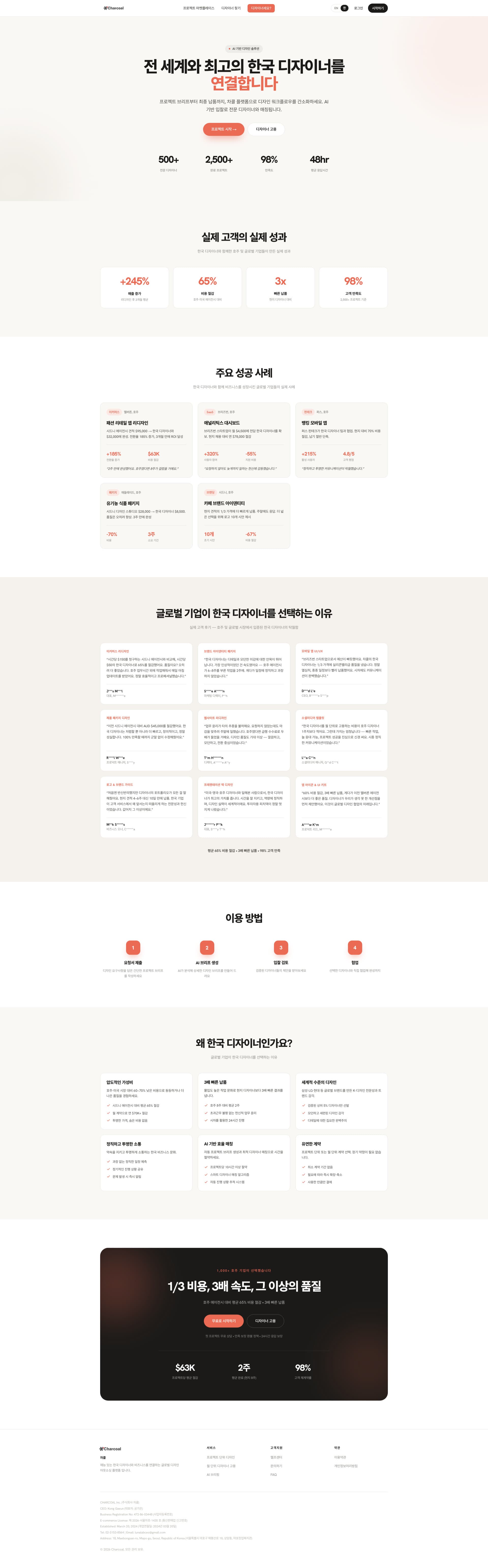
Charcoal is a global design marketplace connecting overseas clients with Korean designers. Its premise is that the bottleneck in outsourced design is not talent but the brief: a non-specialist writes something loose, and the work fails before it starts. Here an AI rebuilds that request into a working design brief, and designers bid against the brief rather than the guess. Request, brief, proposal, payment, delivery, settlement and refund all resolve inside one platform, across two languages.

Scope

  • · Marketplace UI/UX Planning & Design
  • · Next.js 14 Full-Stack Development
  • · GPT-4o Brief Generation Pipeline
  • · Bidding, Matching, Stripe Payment & Refund Lifecycle
  • · Realtime Chat, Bilingual Architecture, Admin Console

Key Technical Features

AI Brief Generation Pipeline

  • · An 18-field request is converted by GPT-4o into a structured design brief, with the model judging where information is missing and recommending follow-up questions in JSON mode.
  • · The same brief also generates a designer-facing work guide. Generation is best-effort — a failure never breaks the request flow.

Bidding & Payment Lifecycle

  • · Project posting, designer proposal, selection, Stripe Checkout, deliverable upload with signed-URL download, completion approval, and fee-split settlement are connected as a state machine.
  • · Permissions at each stage are verified by server guards rather than trusted from the client.

Refund Workflow & Stripe Refunds API

  • · Customer refund request through admin full/partial/reject decision is modelled as three states.
  • · On approval, stripe.refunds.create issues the real refund, followed by in-app and email notification.

Realtime Chat & Notification

  • · One-to-one messaging on Supabase Realtime.
  • · Proposal, award, deliverable, completion, refund and settlement events fire in-app notifications alongside Resend email, with DKIM and SPF authenticated on the sending domain.

Store-both i18n Architecture

  • · Static UI uses a key dictionary; user-generated content — requests, briefs, proposals — is stored in both languages in a general Translation side-table.
  • · The source language is detected and the opposite translated automatically. Adding a language adds rows, not a schema migration.

Security Hardening

  • · Row-level access is controlled by 21 RLS policies across 7 tables.
  • · A privilege escalation path — the signup trigger trusting a user-supplied role — was closed. The admin console is fully separated from the user app by private-path rewrite, role guard and session isolation.

Design Points

Warm Coral & Cream Palette

Outsourcing platforms default to a clerical, transactional look. A coral and cream base with GSAP and Lenis inertial scrolling and reveal motion was used instead — the first impression argues that this is a place where design work is respected.

Dual-Audience UX

Client and designer want opposite things from the same service, so each gets a dedicated landing, contextual header and dashboard. Splitting the routes was cheaper than compromising both.

Gallery

Click to enlarge
View ProjectView Website

Next Project

JENGIO

Membership Commerce — Subscription Platform

Keep scrolling